Fixora Global Hub
An end-to-end, two-sided services marketplace connecting Nigerian customers with skilled artisans through job posting, bidding, real-time communication, identity verification, payments, reviews, and marketplace operations.
Role
Product Designer & Full-Stack Engineer
Timeline
2026
Status
Live
Stack
The Problem
Nigeria's artisan economy is still driven by fragmented referrals. Customers struggle to verify skill and accountability, while capable professionals struggle to reach qualified demand and prove their credibility. FIXORA needed to coordinate discovery, trust, communication, work approval, and payment across customers, artisans, and marketplace administrators without exposing private or financial data between roles.
3
Interconnected user roles
23
Application pages
10
Core database entities
≈12k
Lines of TypeScript, SQL & CSS
My Role
Product Designer & Full-Stack Engineer
The Build
Architected three interconnected product experiences for customers, artisans, and administrators. Built authentication, protected dashboards, editable profiles, marketplace discovery, public artisan profiles, category and state filtering, and a multi-step job-posting workflow covering service taxonomy, budgets, timelines, Nigerian location data, and image uploads.
Designed a PostgreSQL model for profiles, jobs, bids, messages, notifications, reviews, transactions, verification applications, job photos, and proof-of-work submissions. Supabase Realtime powers private messaging and unread state; database triggers match new jobs by trade and location and notify customers when bids arrive. Row-Level Security policies protect user-owned data, marketplace transactions, verification records, private messages, and storage objects.
Engineered the bidding and payment lifecycle from bid submission and comparison through acceptance, job-state transitions, Paystack transaction initialization, HMAC webhook validation, server-side verification, escrow state, proof submission, and controlled payment release or refund. Administrators can review identity applications, proof of work, transactions, and manual release decisions. Safe demo modes expose all three dashboards to stakeholders without revealing production user data.
Engineering Highlights
- Role-specific customer, artisan, and administrator dashboards
- Supabase Auth, protected routes, session handling, and editable profiles
- PostgreSQL triggers for trade-and-location job matching and bid notifications
- Row-Level Security across marketplace data, private messages, and storage
- Bid submission, comparison, acceptance, rejection, and job-state transitions
- Paystack initialization, signed webhook validation, and server-side verification
- NIN verification, document upload, browser camera capture, and admin review
- Proof-of-work submission, approval, rejection, and controlled payment release
- Realtime messaging, notifications, unread counters, ratings, and reviews
- Production-aware demo modes, empty states, SEO foundations, and Vercel validation
Product evidence
Product walkthroughs
Click to play · Audio controlled by you
Marketplace experience
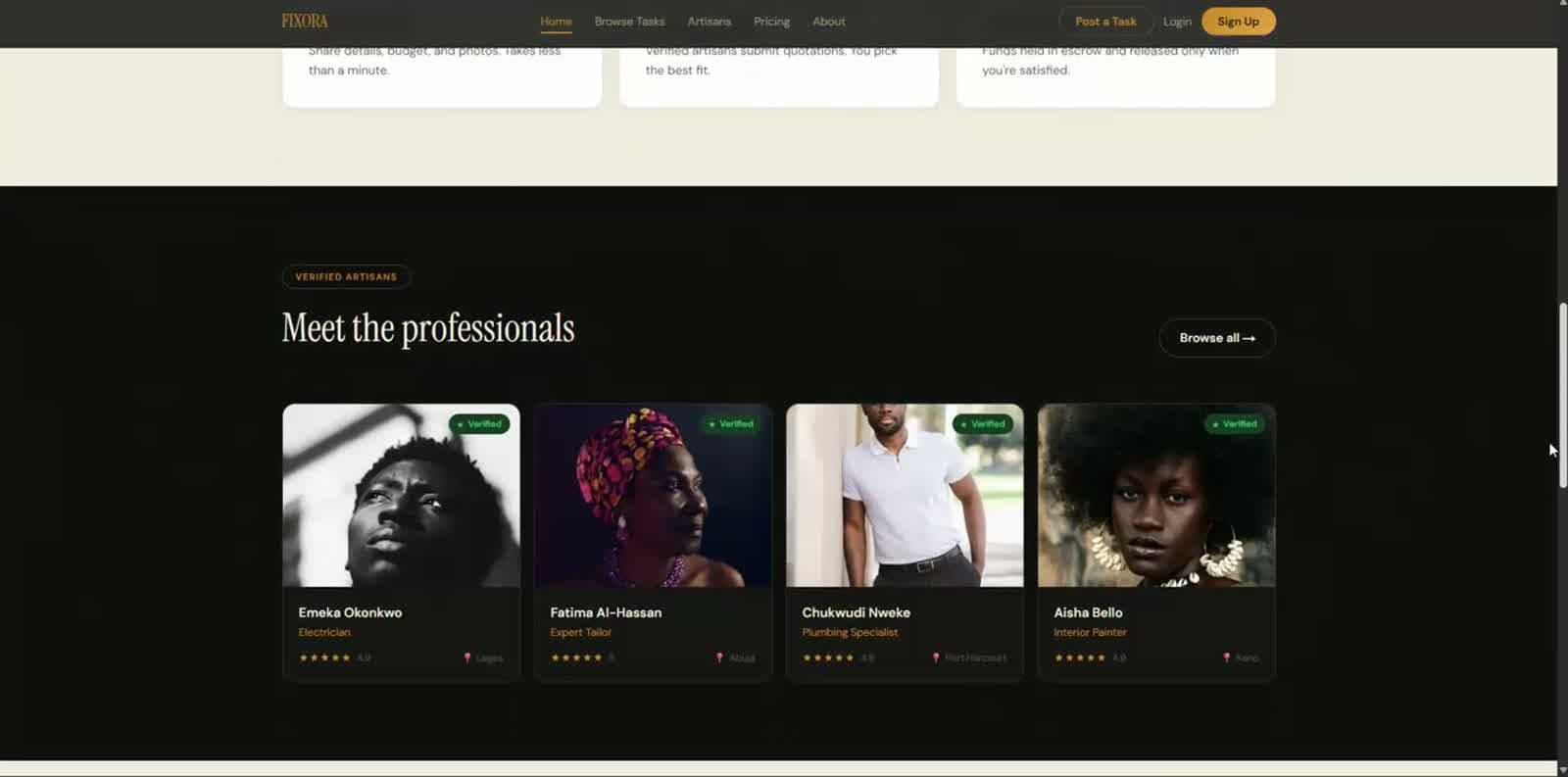
0:41The public marketplace communicates the trust model, introduces verified professionals, and creates clear paths into task posting and artisan discovery.
Multi-step task creation
2:12A structured job-posting workflow captures trade, location, problem context, urgency, budget, timing, and supporting media before matching can begin.
Role-aware onboarding
1:29Account creation branches cleanly between customers seeking help and artisans offering services, while preserving a consistent trust-led experience.
The Outcome
Production-ready marketplace · 3 role-specific products · Secure payment state machine · Verification and proof-of-work operations
One lesson
Marketplace engineering is state-machine and trust engineering. Payments, verification, proof of work, permissions, and messaging only feel simple when the underlying transitions and access rules are explicit, secure, and recoverable.
Tech Stack
Tags
Next project