Enterprise fleet & logistics
Focused engineering case studyFleet systems that move from signal to decision.
I engineer multi-tenant dashboards, telemetry pipelines, driver-risk tooling, and field operations products for enterprise fleets in oil & gas and logistics.
3,000+
vehicles within the operational footprint of systems I work with.
3,000+
vehicles within the operational footprint
Multi-tenant
enterprise environments kept deliberately isolated
Daily
operational decisions supported by live fleet signals
How I work
How I work within a product team.
I collaborate across engineering, product, design, and operations—balancing technical trade-offs with product scope and delivery timelines. I communicate and document progress clearly, and own features through to production.
Discover
Architect
Deliver
Validate
Primary proof
One operational view from fragmented fleet signals.
Built for enterprise fleet operators in oil & gas and logistics. Client identities, branding, and operational data remain private.
The operational problem
I make telematics and logistics operators use their data.
Most telematics and logistics teams already pay for telemetry. The gap is that the data sits outside the workday. I show operators how to put it into exception queues, operational reports, an AI chat that queries the live store, trend views, and Power BI decks their leadership already uses. I start with a working demo so the value is visible before anyone commits budget. Once that lands, I help stand up the team and we ship the dashboard versions they actually run.
Signal path
Provider JSON
SQLite
Postgres
Four tenant dashboards
What I implemented
Isolated multi-tenant dashboards
I ran four enterprise dashboards on one droplet, but each tenant got its own data path. Vehicle rows, reports, and alerts were scoped by tenant ID on every query so one fleet could not read another. Same codebase, separate stores—no shared tables, no cross-tenant joins.
Four isolated dashboards, one deploy
Rate-limited provider sync
I ingested inconsistent JSON from multiple telemetry providers. I could not poll them like a local DB—quotas and stale payloads would fail the job. I batched pulls, normalized each dump before write, and kept the last good record when a provider timed out so the dashboards stayed up.
Sync held under provider limits
JSON → SQLite → Postgres
I started on JSON dumps. File queries stalled, so I moved to SQLite. Concurrent dashboard reads then write-locked the file store, so I migrated to Postgres. The box followed: 1 vCPU / 1 GB / 25 GB at ~$6 until memory and I/O thrashed, then 2 vCPU / 4 GB / 80 GB / 4 TB at $24.
Four tenants on a $24 droplet
The result
A reusable operational foundation that helps teams see fleet state, surface risk, and produce reporting without rebuilding the product for every enterprise environment.
Field operations
Replace the daily chase with a habit people can complete.
Phone calls and spreadsheets made field status slow to collect, inconsistent to interpret, and difficult to audit. The check-in app turns that fragmented routine into a short, repeatable mobile workflow.
Adoption principle
Ask only for what operations needs, make exceptions easy to explain, and confirm clearly that the update was received.
Product thesis
From seeing the fleet to moving it intelligently.
The way I think this category matures
This is my product thesis—not a disclosed employer roadmap. Each stage should remove a more expensive layer of operational uncertainty: first visibility, then context, then coordinated action.
Visibility
Know what is happening.
Bring fragmented vehicle signals into one operational view so teams can move from chasing updates to seeing fleet health, risk, and exceptions as they emerge.
- Real-time telemetry and fleet status
- Event detection and driver-risk panels
- Tenant-aware views and operational reporting
Operational value
Less manual reconciliation, faster exception discovery, and one shared version of fleet reality.
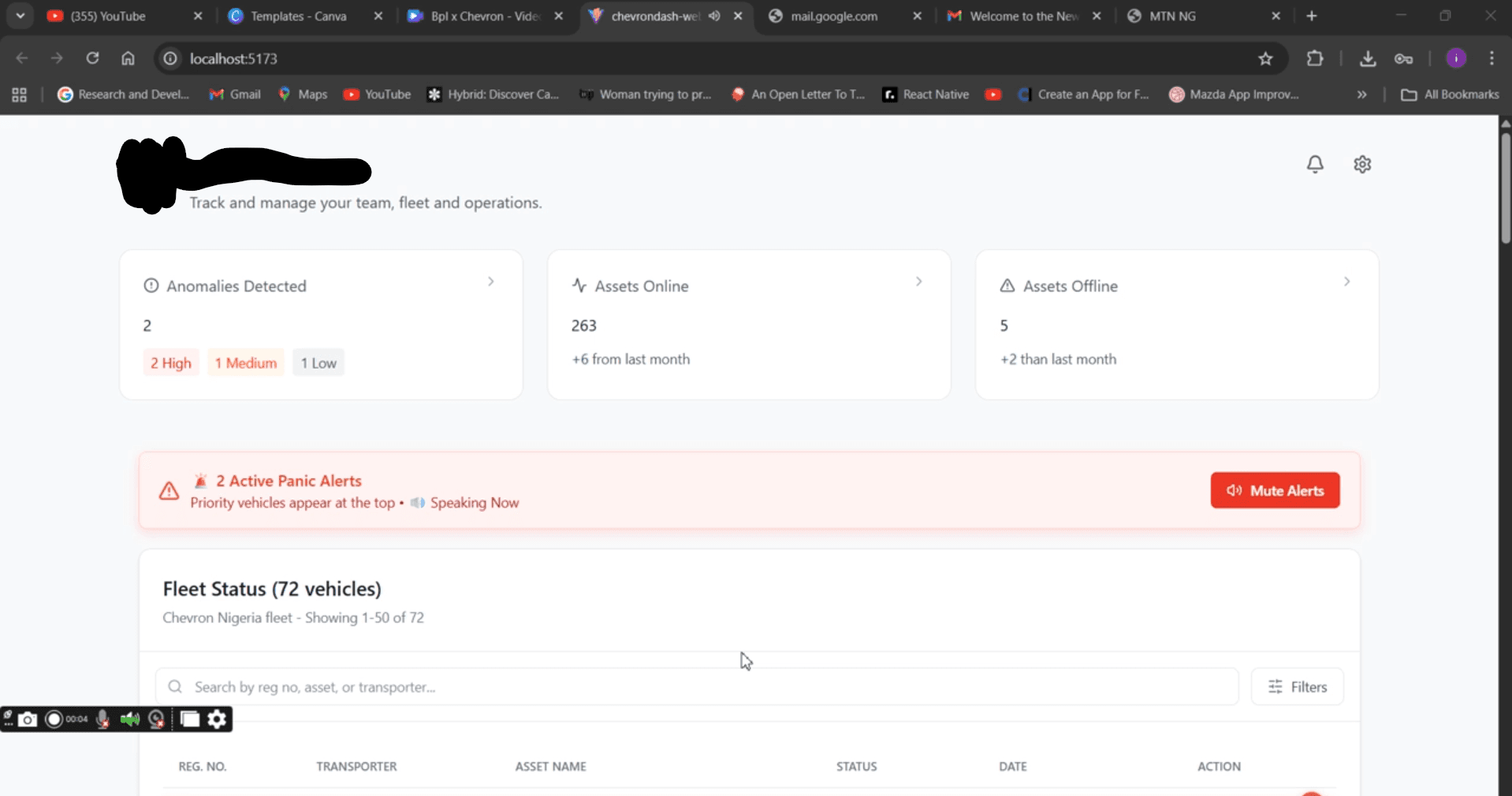
Fleet visibility dashboard
Live fleet state, panic alerts, and exception-first vehicle status.
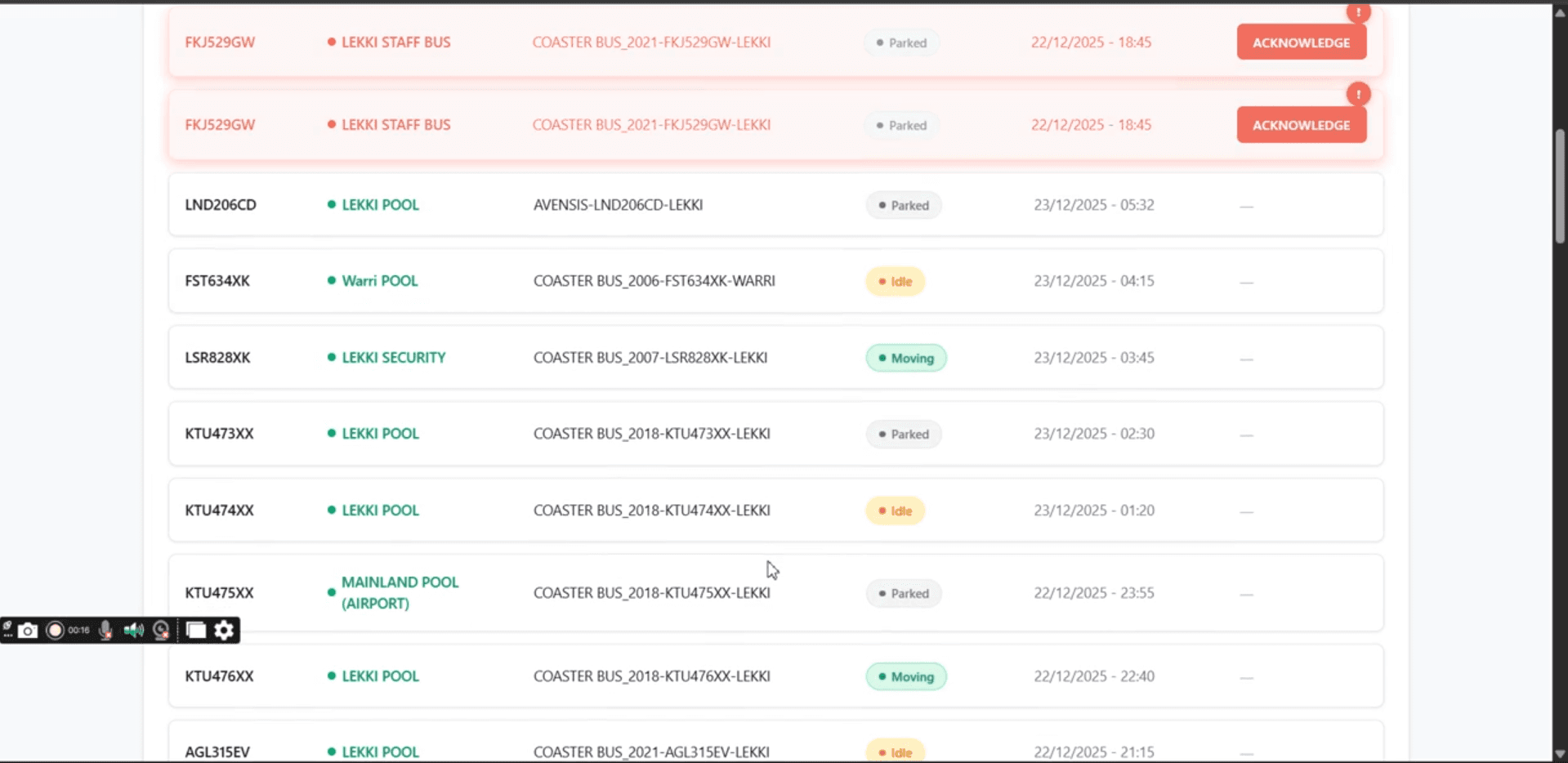
Vehicle status list
Parked, idle, and moving states with acknowledge actions on exception rows.
Context
Understand why it matters.
Move beyond isolated alerts by correlating incidents, location, operating conditions, and external signals into a decision-ready explanation.
- Incident and signal correlation
- Operational context around exceptions
- Prioritized investigation views
Operational value
Teams spend less time interpreting noise and more time acting on the events with material operational impact.
V2 context walkthrough
Screen recording of the context layer: settings, operational views, and how an operator moves from signal to investigation.
Automation & integration
Act before the issue becomes loss.
Turn known patterns into coordinated action: escalate the right event, detect suspicious behavior, surface predictive risk, and deliver answers in the tools operators already use.
- Automated escalation and anomaly detection
- Predictive risk and self-serve reporting
- Conversational access through channels such as WhatsApp
Operational value
Shorter response loops, earlier intervention, and operational intelligence that travels to the user instead of waiting inside a dashboard.
What comes next
Connect the vehicle record to the whole operation.
A fleet/logistics ERP
Fleet operations often split maintenance, compliance, dispatch, cost, and incident records across disconnected tools. This suite gives every vehicle one operational history, so a decision is made with the full asset context rather than whichever spreadsheet was opened first.
ERP suite with fleet module
Business suite overview with fleet management surfaced as a first-class module.
Finance and ledger workspace
Accounting, journals, and trial balance sitting in the same suite as fleet.
Fleet module inside the suite
Live tracking, assets, drivers, reports, and geofencing as one operational surface.
Not built for or with Shell. No affiliation or endorsement is implied.
Applied reimagining
What this thesis could look like in a distributed energy fleet.
The Shell-context exploration is an honest personal concept: a recognizable operating environment used to make the systems thinking concrete. It does not claim access to Shell data, products, or internal operations.
Illustrative operating environments
Named for category fit only. These are not clients or affiliations.
- Example 01

Shell
Energy operations
- Example 02

TotalEnergies
Distributed fleets
- Example 03

Maersk
Logistics networks
- Example 04

DHL
Last-mile operations
- Example 05

Dangote
Industrial logistics
Direct line
Building or scaling fleet technology?
If the team needs an engineer who can connect telemetry, product decisions, and day-to-day operations, let's talk systems.